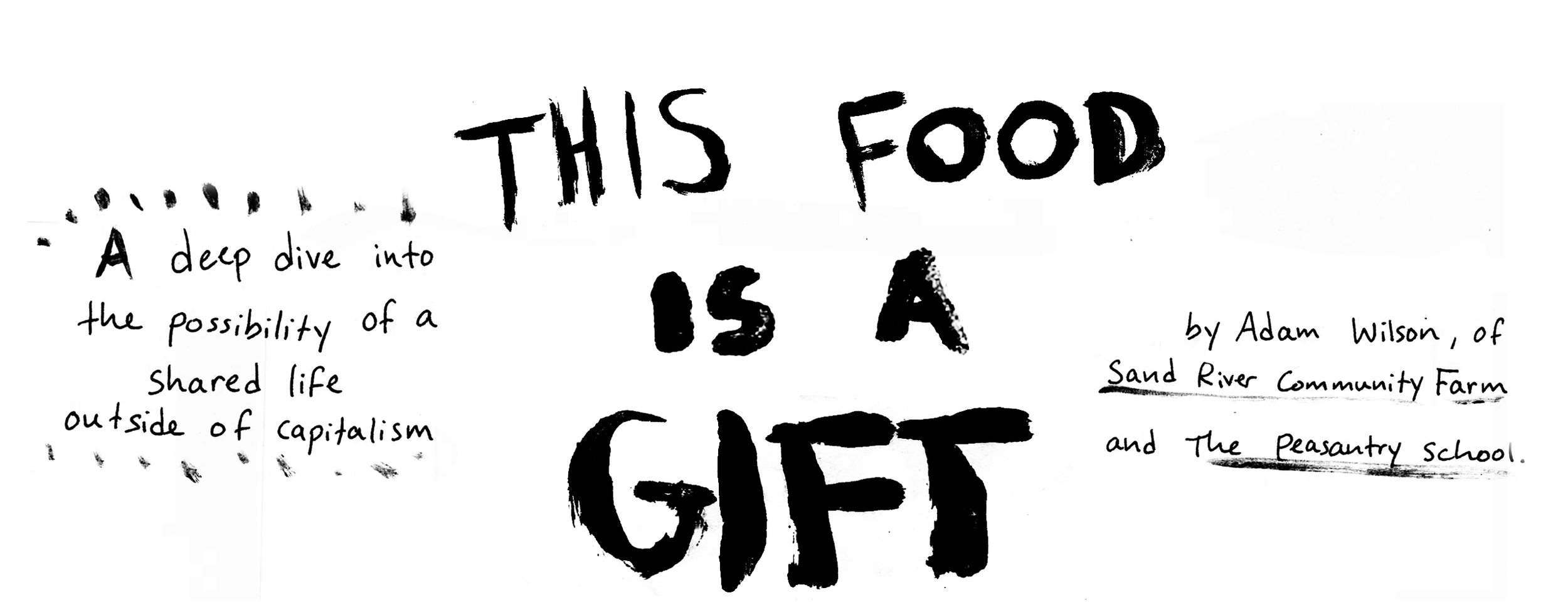
For the past eight years, Adam Wilson has worked alongside his neighbors, human and otherwise, to grow, harvest, preserve, cook and share food as a gift with anyone who is hungry for any reason. He has asked to be sustained rather than paid.
The book that has grown from Adam’s culture-shifting work, This Food is a Gift: Practical Experiments in Neighborly, Non-Market Farming and Feeding, opens a door to the emergent field of gift economics by offering a loving corrective to a world wherein every plate of food and plot of land—every winter jacket and warm bed—lies behind a locked door to which money is the only acceptable key. Get ready to step through the back of the wardrobe and plant your feet upon an Earth who never agreed to be put up for sale. She has been waiting, patiently, to welcome you back home.
This website will act as a platform for people to receive This Food Is a Gift—slated for publication in early 2027 by Hancock House Publishing and As Is Press—and participate in a financial conversation to enable others to receive the gift as well.
Would you be willing to receive this book as a gift?
Sign up for email notifications about the book:
🌻 Become a sustainer 🌻
Donate to help fund the publishing effort:
You can learn more about Adam’s work on his Substack.
Preface to This Food is a Gift:
Practical Experiments in Neighborly, Non-Market Farming and Feeding
This Book is a Gift: Falling Back into Practice.
You hear a knock at your door. Hello, it’s me, a stranger, holding a quart of the beef and corn chili we just made here at Sand River Community Farm, a patch of Earth where nothing is for sale. I introduce myself and ask, “Would you be willing to receive this gift of food?” Again and again, I hear people say: “But surely someone needs this more than I do.” Can you imagine how different the world would be if everyone wrestled with that thought as they wandered the aisles of the grocery store, or any store for that matter?
For the past eight years, I have worked with my neighbors to grow and offer food as a gift to anyone who is hungry for any reason. It has become abundantly clear to me that modern people are a lot more comfortable giving than receiving, which points us toward the central assertion of this book: the transactional norms of the marketplace have left our gratitude muscles badly atrophied.
The gratitude I am describing is less a spoken laundry list of the things that worked out for us today than an awareness of our deep-running relational obligations to people and place. Belonging isn’t something we find or feel. It is something we do.
If this book is to serve as a practical guide to agricultural gift economics, we’ll have to get clear on what we mean by the word practical. The Greek root praxis means exercise, or action. It means doing something, not just talking about it. The type of gratitude I am talking about moves us from noun to verb, from emotion to motion. It turns warm fuzzy feelings into cultural organizing principles.
In the presence of food that is for sale, we tend to ask, “What do I want?”, “How much does it cost?” and “Can I afford it?” The locus of consideration is the self, the same one doing the asking and the answering. The same one we disparagingly call a consumer.
In the presence of free food, we tend to stuff our bellies and our pockets. We tend not to worry about where the food came from, how it became available to us, or what it means for us to eat it.
“I paid for it” and “I got it for free” result in the same market-specific condition we might call ‘freedom from relational responsibility’.
In the presence of food that is a gift, the needs of others spring to mind: “Surely someone needs this more than I do”. In their gentle protestations, I hear people asking, “Am I worthy, or could I imagine myself so?”, “What is an appropriate portion size”, “Are all the other neighbors being sustained?” and “How might I go about making sure that is the case?” This is the sound of gratitude creaking into motion by turning the human heart toward relationship. This is the sound of a consumer becoming a sustainer.
If you go to a yoga class, you will spend that hour abstaining from more comfortable or affirming behaviors–say scrolling on your phone. If you agree to receive a gift of food you will abstain from the more familiar pattern of paying your way off the relational hook. You decide to practice something specifically because it isn’t your preference, by abstaining from that which is.
If you bruise or break your ankle, you might lean on crutches to help you get around. But prolonged use of crutches will lead to weakness, even atrophy. Buying and selling may indeed help us access our daily bread in a landscape of strangers. But the market enables us to choose the comfort of anonymity over the weight-bearing work of relational maintenance–to estrange ourselves from the sources of our lives. The loneliness epidemic and the ecological crisis may be two different symptoms of the same cultural atrophy.
Sharing food as a gift is a bit like setting down the crutches and inviting the neighbors to do the same. Our first tentative steps may be awkward, even painful. We are likely to fall down. But, over time, we might remember how to catch one another. Our lives might begin to look like a series of trust falls. It might prove a whole lot less lonely.
If the process of placing price tags on every plot of land and plate of food has proven highly effective at turning human beings into scarcity-fuelled, dollar-empowered, desire-driven consumers, who will we become if we exercise other muscles? What might we remember if we practice other forms of relationship?
Giving and receiving food as a gift offers one way to begin repairing our relationships to one another and the greening land. It’s certainly not the only way, but it’s the one I have been experimenting with for eight years now. Sharing those stories as a gift in the form of this book may be another way to strengthen relational muscles. Will you take my hand and step outside of the marketplace with me?
This book is being offered to you as a gift, which means that you will be granted a break from having to be a consumer for however long it takes you to read it. You are being invited to practice sustaining instead. You are being invited into a web of unprescribed relational responsibilities to other humans and the living Earth. You are being invited to figure out how to keep the book and its underwriters in mind, starting with the forest trees whose bodies became the volume in your hands. Those trees, and the nest-bound hatchlings who made home in their branches, loved being alive as much as we do. Bearing weight on atrophied muscles includes learning to carry grief, a sibling to gratitude.
How will we live once we’ve remembered that Life arrives in our hands by ending other lives? Awestruck gratitude could become our collective response to that question–our cultural and ecological organizing principle.
So, here is the invitation before you: don’t buy this book. Practice receiving it instead. If you’ve already purchased the book through the standard market channels, don’t worry. You are still invited to the gratitude practice party, because the price you paid did not include an author payment. That’s right. I, Adam, am asking to be sustained rather than paid. I am inviting you to consider keeping me, my family, the Farm, and my neighbors in mind. See below for ways to go about doing that.
I am immensely grateful for the large-hearted team at Hancock House Publishing and As Is Press for humoring my hunch that we humans were in fact born with gratitude muscles–however atrophied they may now be. This book offers an invitation to set down the crutches and practice bearing the weight of our lives together. I can assure you it won’t be boring; beyond that, no promises. Practices aren’t action plans toward a desired outcome; they are thresholds to the unknown. At thisbookisagift.org, you will be able to:
Request a copy of the book as a gift.
Learn about the monetary costs associated with printing and distributing a book as a gift within the modern world.
Decide to become a sustainer by contributing money to the Gift Fund, which allows the book to move through the world in this undefended way. If the Gift Fund goes to zero, gift copies will become temporarily unavailable.
Contribute to the author’s Monthly Personal Stipend Request. Once his Stipend Request has been fulfilled, no further money will be requested until the following month.
Learn how to become a sustainer in other, non-monetary ways. Not everyone’s gift is money. Thank goodness, for what a boring world that would be.
Welcome to the table. There is a place here for you. This food, and these stories, are offered as gifts to anyone who is hungry or weary for any reason. Who will we be to one another after we’ve pushed in our chairs and walked away from the table? That’s what we’ll have to figure out together, in conversation. That conversation could become the rest of our lives. For that I pray.
With gratitude,
Adam